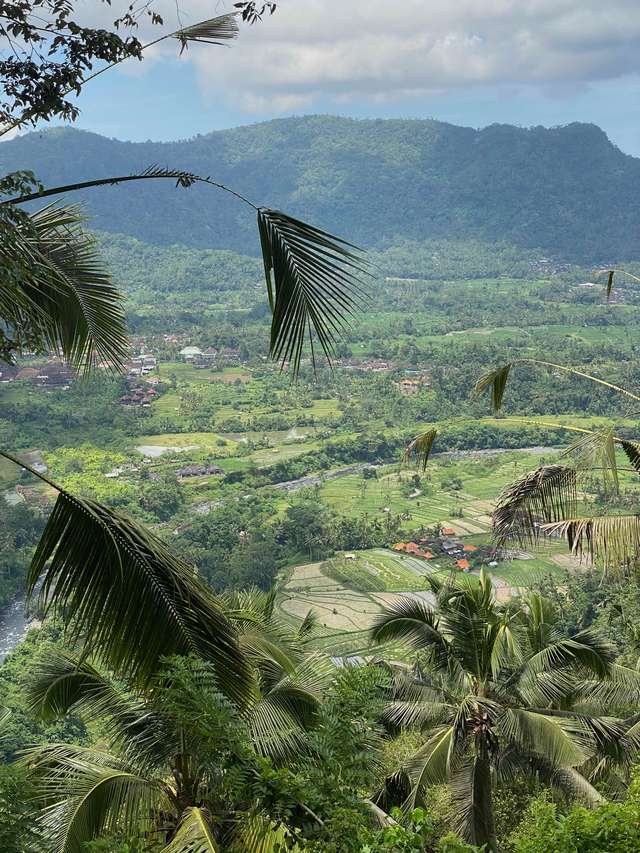
A farming valley in east Bali, under Mount Agung. An hour on from Ubud, two from the airport, and half an hour above the coast road.
From the airport
2 to 2.5 hours
About 70 km east, through Klungkung.
From Ubud
About 1.5 hours
The usual second stop on an east Bali loop.
How long to stay
Three nights, minimum
Two get eaten by the drive in and the drive out.
What it is not
Beaches or nightlife
The coast at Amed is another hour on.
A working farming valley in Karangasem, east Bali, that people keep comparing to Ubud thirty years ago.
A valley of terraced rice and vegetable fields running down from the southern flank of Mount Agung, in the Karangasem regency. People here farm, and they weave: Sidemen is one of the last places in Bali still making endek and songket by hand on backstrap looms, in workshops you can walk into.
It looks like the photographs of Ubud from thirty years ago, for the straightforward reason that nothing much has been built here. There is no strip of bars, no traffic to speak of, and after dark it is genuinely dark. Most days are walking the terraces, sitting somewhere with a view, and watching the weather move across Agung.
Nobody in the valley is performing a village for you. The ceremonies happen on their own calendar whether or not there is anyone watching, the terraces are somebody's income rather than a backdrop, and both are better for it.
The valley has no entrance, no ticket and no car park, because there is nothing to park for.


The valley is not far from anywhere. It is just slow to reach, because almost none of the road between here and there is fast, which is why the hours below are worth more to you than the kilometres.
There is no bad month in the valley, only different ones. What actually varies is how much rain falls in the afternoon and how many other people are on the road, and neither varies as much as the dry-season advice everywhere else would suggest.
Jan
Quiet
Feb
Quiet
Mar
Quiet
Apr
Building
May
Building
Jun
Busy
Jul
Busiest
Aug
Busiest
Sep
Busy
Oct
Building
Nov
Quiet
Dec
Busy
Bar height is rainfall against the wettest month of the year, not a forecast. In the green season the rain usually arrives in the afternoon and has cleared by evening, so the mornings are yours either way. The busiest months are also the driest, which still means you will pass more farmers than tourists.
Every farmer plants on their own cycle, so a mirror-flooded terrace and a chest-high crop sit side by side in the same week. No month guarantees the photograph you have in mind, and every month has some of it somewhere in the valley.
May, June and September. Dry enough for a full day of walking, before and after the two months everyone else picks. October is the quiet bet: the rain has not properly returned and the valley has emptied out again.
Two dates worth checking before you book
Nyepi, the day of silence, falls in March and moves each year. The whole island stops: no travel, no lights after dark, the airport shut. Spend it inside somewhere you like and it is extraordinary. Try to arrive or leave on it and you cannot.
Galungan and Kuningan come around every 210 days, so they drift through the calendar. Every house puts up a penjor, the whole valley is in temple dress, and it is the best week of the year to be here.
Less than they planned, is the usual answer, and that is the point. Here is what the days fill up with when they do.

Paths run between the rice fields from most guesthouse doorsteps, and they are the earth banks farmers use to reach their own plots rather than anything laid out for visitors. Half a day gets you down to the river and back with nobody else on the trail. The ridge up at Bukit Tageh is the view everyone ends up photographing.

The Unda runs stony and fast through the bottom of the valley, an hour or so below the village on foot. It is a walk and a place to sit rather than a swim, and it is the coolest air you will find all day. Further up the same water, near Muncan, it is the Telaga Waja and people raft it.

Village temple ceremonies run on their own calendar and are not staged for anyone. Dress properly, stay at the back, and wait to be waved forward rather than walking in.

The dancers are the children of the village and they have been rehearsing for weeks. It is the least polished and by some distance the best dance performance you will see in Bali.

The mountain is the view from half the valley and is out most clear mornings before the cloud builds. The sunrise trek starts around midnight and needs a licensed guide. Gembleng waterfall, a short steep walk above the terraces, is the version that takes an hour.

Besakih, the mother temple, is about thirty minutes north and best done before the coaches. Tirta Gangga, the water palace with the stepping stones, is about an hour east. Either is a morning; both in one day is a lot of car.
Not a schedule. It is the shape three nights takes when people stop trying to fit the island into them, written out because "three nights minimum" is easier to believe when you can see what fills them.
01
Day one
The drive in is most of the day whichever direction you come from, and the valley does not reward arriving in a hurry.
02
Day two
The one full day, and the reason three nights is the minimum. Everything here is on foot from the village.
03
Day three
Three options, and the mistake is trying for two. Everything below is a car and most of a day once the driving is counted.
A fourth night is where the walking gets good, because it is the first one you spend without an arrival or a departure in it. A fifth is when people start rearranging the rest of the trip.
A short list, not a search engine. These are places in the valley we know, booked directly with the people who run them.

Griya Valud Sidemen
Sidemen, Bali
From Rp 650.000 a night

Mountain Bamboo House
Sidemen, Bali
From Rp 6.300.000 a night

Paddy Bamboo House
Sidemen, Bali
From Rp 4.100.000 a night
Every one of them is booked with the property itself. No booking fee, no cut taken by us, and the rate is between you and the owner.
There is no public transport into Sidemen. No airport bus, no train, nothing running to a timetable. Everyone arrives by road, and almost everyone by car with a driver. It is a straightforward drive, and there are two things worth knowing before you make it: how long it really takes, and what happens in the last twenty minutes.
From Bali airport (DPS)
2 to 2.5 hours
About 70 km east, through Denpasar and along the coast to Klungkung. Closer to three hours if you land between four and seven in the evening, when the road out of Denpasar is at its worst.
Bali airport (DPS) to Sidemen, in full →
From Ubud
1 to 1.5 hours
Only 35 km, and almost none of it is fast road. You cross river valleys the whole way, dropping down and climbing back out four or five times. It is one of the better drives in Bali.
Ubud to Sidemen, in full →
Sidemen is a working valley, and the work is worth an afternoon of anyone's trip. None of it is a demonstration put on for visitors.

None of it is difficult. All of it is easier to know at home than to find out on the first evening.
If you want rice terraces without a queue for the photograph, yes. Sidemen is a working farming valley rather than an attraction, so there is no entrance gate, no swing, and no car park. What it has instead is terraces you can walk into from your doorstep, a view of Mount Agung on a clear morning, and villages going about a normal week. If your Bali list is beach clubs and nightlife, it is the wrong valley and you will be bored by the second afternoon.
Three, minimum. Two nights gets eaten by the drive in and the drive out, and the whole point of the valley is the day in between, when you have stopped planning anything. Most people who budget two end up moving something later in their trip. Four or five is not too many if you plan to walk.
By arranged car, in about two to two and a half hours, covering roughly 70 km east through Klungkung. There is no public transport into the valley and ride-hailing apps will not reliably accept the fare, so a car booked in advance is how essentially everyone arrives. We publish fixed fares rather than quoting on request, and your stay can usually arrange the same thing.
It is quieter, greener and about ninety minutes away, and it is not a substitute. Ubud has the restaurants, the yoga, the galleries and the airport connections; Sidemen has almost none of that and is the better place to do nothing. The usual answer is both: a few nights in Ubud, then east to Sidemen for the part of the trip you will actually remember.
Honestly, no, and that is most of the appeal. There is no strip of bars and no late kitchen. Guesthouse restaurants wind down around nine, after which the valley is genuinely dark and the loudest thing is the frogs. Bring a book. If you want a night out, it is in Ubud or on the coast.
Not to enjoy the valley, since the walking starts at your door. A scooter opens up the wider area, but the lanes here are steep, narrow and often wet, and this is not the place to learn to ride. If you are not already confident, your stay can arrange a driver for the day for less than a bad afternoon costs.
It is one of the cheaper places in Bali to spend a day and one of the more expensive to move around in. Rooms and food cost less than the equivalent in Ubud or on the south coast, often considerably less. What costs more is transport, because every trip out of the valley is a car for the day rather than a five-minute ride-hailing fare. Budget for the room, then budget separately for the driving.
It is a farming village, so the risks are the ordinary ones: unlit lanes after dark, wet earth paths, and a mountain road driven by people in a hurry. Petty crime is not what people here worry about. Children do well in the valley and are made a fuss of everywhere, with two caveats worth planning around: the terrace paths are narrow drops that are no place for a toddler who runs, and there is nothing at all to do in the evening, so bring whatever fills that.
Not really, and it surprises people who have seen photographs of the river. The Unda is stony, fast and cold, and it is a walk and a place to sit rather than a swim. Several stays have pools, which is what most people use. For actual sea swimming the nearest is the coast around Padang Bai and Candidasa, roughly an hour, or Amed about half an hour further on.
Some, but this is not a place you have to arrive loaded. There are working ATMs in the village: Mandiri, BPD and BRI all have machines. Guesthouses and the larger restaurants usually take cards, and almost nothing else does, so carry enough rupiah for warungs, drivers, workshops and offerings and top up in the village rather than at the airport.
East or south, mostly, because you are already halfway there. Amed for diving and the black-sand coast is about an hour and a half; Padang Bai for the fast boats to Lombok and the Gili islands is about an hour. Going back west to Ubud or the airport is the same drive you came in on. Very few people go from here to the south coast without stopping, and the ones who do regret starting it at four in the afternoon.
Longer answers to the things the front door only has a paragraph for. Written by people who live an hour from the valley. Nothing here is sponsored and nothing here is for sale.
Before you come
Sidemen or Ubud
It is the question people ask before their first trip east, and the honest answer is that it is not really a choice. Here is how the two actually differ, and how to decide if you genuinely only have time for one.
Before you come
Three days in Sidemen
Everybody who has been here says three nights minimum, and nobody says what fills them. This is the shape three days takes once people stop trying to fit the rest of the island into them.
Before you come
Things to do in Sidemen
Sidemen has very little to do and that is why people come. Here is all of it, sorted by how far you have to go, including the honest list of what the valley does not have.
Before you come
The best time to visit Sidemen
Every page says April to October, which is the answer for the whole island and does not describe this valley. What changes here month to month is smaller than you would think, and the terraces ignore the calendar completely.
Getting here
Bali airport (DPS) to Sidemen
Seventy kilometres east, and anywhere from two hours to three depending entirely on what time you land. Why the evening is the worst moment to leave the airport, what a car costs, and how to have one waiting when you walk out.
Getting here
Ubud to Sidemen
Thirty-five kilometres that drive like eighty, dropping into and climbing back out of four or five river valleys in a row. One of the better roads in Bali, what a car costs, and the stops worth making on the way.